Cybersecurity in the Age of Convergence: Protecting Your Integrated Systems

In today’s interconnected world, the integration of Operational Technology (OT) and Information Technology (IT) has revolutionized industries, driving efficiencies and enabling new capabilities. However, this convergence also brings a host of cybersecurity challenges that must be addressed to protect critical infrastructure and sensitive data. The Complexities of OT and IT Integration Operational Technology (OT) encompasses hardware and software that detects or causes changes through direct monitoring and control of the enterprise’s physical devices, processes, and events. Information Technology (IT), on the other hand, involves systems used for data-centric computing. The integration of these two distinct domains can lead to several cybersecurity issues: The Growing Need for Cybersecurity Addressing the cybersecurity challenges in integrated OT and IT environments requires a comprehensive and unified approach. Here are some key strategies: 1. Comprehensive Risk Assessment Conducting thorough risk assessments is crucial. This involves identifying vulnerabilities in both OT and IT systems and understanding how these vulnerabilities can be exploited. A detailed risk assessment helps prioritize the areas that need immediate attention. 2. Network Segmentation By segmenting networks, organizations can isolate critical OT systems from the broader IT network. This reduces the risk of lateral movement by attackers within the network. Implementing robust firewalls and access controls between segments ensures that even if one part of the network is compromised, the rest remains secure. 3. Advanced Threat Detection Utilizing advanced threat detection systems, such as Intrusion Detection Systems (IDS) and Security Information and Event Management (SIEM) tools, is essential. These systems provide real-time monitoring and analysis, allowing for the quick detection and response to potential threats. 4. Endpoint Security and Patch Management Securing endpoints, including industrial control systems and user devices, is vital. This includes deploying anti-malware solutions, implementing strong access controls, and ensuring regular patch management to address vulnerabilities promptly. 5. Continuous Monitoring and Improvement Cybersecurity is not a one-time effort but a continuous process. Regular security audits, ongoing monitoring, and updating security measures to counter emerging threats are necessary to maintain a robust security posture. The Role of Human Factors Human error is often a significant factor in cybersecurity incidents. Comprehensive training programs for employees on cybersecurity best practices, awareness of phishing attacks, and proper handling of sensitive information can significantly reduce the risk of security breaches. Case Studies of Effective Cybersecurity Integration Organizations across various industries have successfully navigated the complexities of OT and IT integration by adopting these strategies. For example, a large manufacturing company implemented network segmentation and advanced threat detection to protect its integrated systems. This approach not only enhanced security but also ensured compliance with industry regulations. The convergence of OT and IT systems presents a complex cybersecurity landscape. However, with the right strategies, it is possible to protect your integrated systems effectively. Investing in robust cybersecurity measures not only protects your infrastructure and data but also ensures operational continuity and compliance with industry standards. At Pegasus Consultancy, we specialize in securing integrated OT and IT environments. Our team of experts offers a unified approach to cybersecurity, ensuring that your operations and data are protected against a wide range of threats. From comprehensive risk assessments to advanced threat detection and continuous monitoring, we provide tailored solutions that address the unique challenges of OT and IT convergence. Contact us today to learn how Pegasus Consultancy can help secure your technological ecosystem in the age of convergence. Let’s chat! Contact us today!
Facing the VMware Dilemma: Is It Time to Switch?

The IT industry is abuzz with news about VMware’s recent pricing changes under Broadcom’s ownership. As enterprises across Europe and the Middle East grapple with these adjustments, it’s crucial to assess the impact on your business. Our team is poised to assist you through this transition, offering expert support and innovative solutions tailored to your needs. Latest News on VMware and Broadcom Broadcom’s acquisition of VMware has led to significant changes in pricing and licensing, causing widespread concern among VMware’s customer base. According to Licensing Data Solutions, the new changes, effective in 2024, include substantial price hikes and a shift away from perpetual licenses. This development has led many businesses to consider alternatives to avoid escalating costs and potential support issues. As reported by The Register, Gartner has advised that many VMware customers fear the Broadcom acquisition will stall innovation and increase costs. Smaller and midsize customers are particularly worried about being deprioritized in favour of larger clients, with Broadcom expected to focus its attention on the latter. This shift could lead to an influx of customers looking to migrate away due to extraordinary price increases and challenges with support. Additionally, influential voices in the VMware community, such as those highlighted by the Influence Marketing Council, are actively discussing these changes and their implications for the broader IT landscape. This discourse underscores the importance of staying informed and prepared to adapt to the evolving situation. Pros and Cons of Keeping VMware vs. Exploring Alternatives Evaluating the pros and cons of maintaining your current VMware environment versus exploring alternative solutions is crucial. Below is a table to help you make an informed decision: Aspect Staying with VMware Exploring Alternatives Pros Established platform with comprehensive features Potentially lower costs and flexible licensing options Extensive support and community resources Avoid potential price hikes and unfavorable licensing changes Strong integration with existing VMware environments Access to innovative solutions from emerging vendors Broad third-party support for VMware products Customizable and scalable solutions to fit specific business needs Cons Potentially significant price increases under Broadcom Migration costs and potential initial disruption Uncertainty around future support and innovation Need to train staff on new systems and processes Shift away from perpetual licenses to subscription-based models Possible compatibility issues with existing infrastructure Focus on larger clients may deprioritize support for midsize and smaller businesses Risk of relying on less established vendors Pros and Cons on keeping VMWare and what are the alternatives? Why Enterprises Need a Partner? As you navigate these changes, Pegasus stands out as a reliable partner with the expertise to guide you through this challenging landscape. Here’s why you should consider us: Are VMware’s new pricing and licensing changes affecting your business? Don’t wait until it’s too late. Contact Pegasus IT Services today for a consultation and discover how we can help you navigate these changes, optimize your IT environment, and ensure continued success. Our experts are ready to assist you in developing a customized plan that addresses your unique challenges and goals. Let us help you stay ahead of the curve and maintain a competitive edge in the ever-evolving IT landscape. Reach out to our team today and take the first step towards a more efficient and cost-effective IT strategy. Let’s schedule a FREE consultation session!
The Strategic Value of IT Professional Services in Today’s Business Landscape

In an era where technology rapidly evolves and becomes increasingly integral to business operations, professional services play a crucial role in helping companies stay competitive and agile. These services encompass a wide range of functions, from consulting and strategy formulation to implementation, management, and optimization of IT solutions. As businesses seek to leverage the latest technological advancements, the demand for expert IT professional services continues to grow. Why IT Professional Services Are Essential? 1. Expert Guidance and Consultation IT professional services provide businesses with access to expertise that might not be available in-house. For instance, specialists in areas like cloud computing, data analytics, and cybersecurity can offer insights and guidance that drive strategic decisions, ensuring that IT investments align with business goals. 2. Enhanced Efficiency and Productivity One of the primary benefits of IT professional services is the optimization of business operations. By implementing modern technologies and improving IT infrastructures, professional services help streamline processes, reduce downtime, and increase productivity. This not only boosts operational efficiency but also enhances employee satisfaction by enabling them to work more effectively. 3. Risk Management and Compliance With the increasing complexity of regulatory environments, maintaining compliance is more challenging than ever. IT professional services help businesses navigate these waters by ensuring that their IT systems comply with relevant laws and regulations. Additionally, these services can enhance risk management through robust cybersecurity measures and disaster recovery plans. 4. Scalability and Flexibility As businesses grow, their IT needs evolve. IT professional services enable scalability without the typical overhead associated with expanding in-house teams. Whether scaling up to meet growing demands or scaling down in response to market shifts, IT professional services provide the flexibility needed to adapt quickly. 5. Focused Innovation In today’s digital age, continuous innovation is key to staying ahead. IT professional services foster innovation by introducing cutting-edge technologies and methodologies. This not only helps businesses keep pace with technological advances but also encourages a culture of innovation within the organization. Pegasus: Excellence When Comes to Delivering Professional Services At Pegasus, we pride ourselves on delivering high-impact IT professional services that connect the disconnected and maximize business system value. Our approach is tailored to each client’s unique needs, focusing on providing value through our expertise. What Sets Pegasus Apart: Conclusion IT professional services are more than just an operational necessity; they are a strategic enabler that can transform businesses. With the right partner like Pegasus, companies can not only adapt to the digital age but thrive in it. We invite you to explore how Pegasus can elevate your IT capabilities and drive your business forward. To learn more about our services and how we can help your business achieve its technology and operational goals, visit our Pegasus IT Professional Services page. Are you ready to harness the power of expert IT professional services? Contact Pegasus today to discuss your IT challenges and discover tailored solutions that can propel your business to new heights. Connect with us for a consultation and begin your journey towards enhanced IT efficiency and innovation.
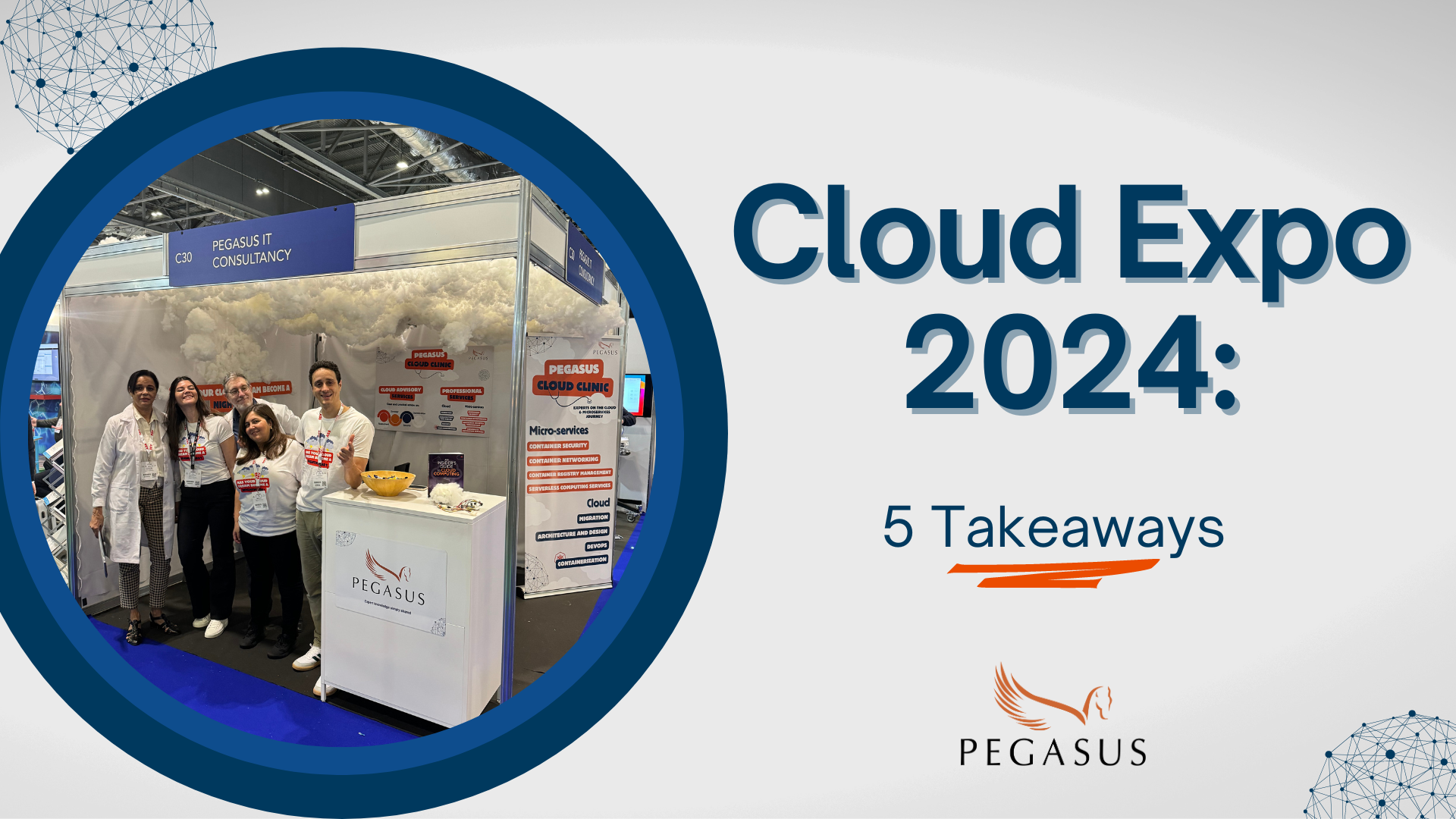
Pegasus at Cloud Expo Europe 2024 — Our 5 Key Takeaways

This past March, Pegasus had the privilege of participating in Cloud Expo Europe 2024, the continent’s largest and most comprehensive cloud event. As leaders in deploying containers, accelerating cloud projects, and re-architecting applications, the event was an exhilarating opportunity for our team to share insights, learn from peers, and realign our strategies with the latest in cloud innovation. 1. The Evolving Landscape of Cloud Integration One of our main takeaways from the event is the rapidly evolving landscape of cloud integration. As a company deeply involved in integrating applications, especially legacy systems, we observed a significant shift towards more streamlined and efficient integration technologies. The discussions emphasized the importance of agile methodologies and continuous integration/continuous deployment (CI/CD) pipelines, underscoring the need for businesses to adapt swiftly to new technologies while ensuring system interoperability. 2. The Push Towards Hybrid Cloud Solutions Throughout the expo, the buzz was all about hybrid cloud solutions. Many sessions highlighted the need for flexibility between on-premise and cloud environments, a domain where Pegasus excels. Our expertise in working with both on-premise vendors like Cisco and Dell and cloud platforms such as AWS, Google Cloud, and Azure positions us uniquely to help businesses navigate this complex landscape. The increasing demand for hybrid solutions resonates with our recent shift to focus more on the UK market, where businesses are keen on achieving the optimal balance between cloud agility and on-premise security. 3. Kubernetes and Containers: The Stars of the Show Kubernetes and container technology were undoubtedly the stars of Cloud Expo Europe 2024. As we specialize in deploying containers and orchestrating them through Kubernetes, the event provided us with fresh perspectives on optimizing these technologies for performance and scalability. The sessions dedicated to Kubernetes and Rancher offered fascinating insights into best practices for container management, something our engineering team is eager to implement and refine in our projects. 4. Increased Emphasis on Cloud Security and Compliance With the surge in cloud adoption comes a heightened focus on security and compliance. We attended several enlightening talks on the latest strategies to enhance cloud security postures and meet stringent compliance requirements. As a services-only organization, it’s imperative for us to stay ahead of these developments to provide our clients with the most secure and compliant solutions, particularly in regions as diverse as Europe and the Middle East. 5. The Importance of Open Source and Community Collaboration At Pegasus, our development team’s foundation in open-source software was mirrored by the community spirit evident at the expo. The open-source sessions reminded us of the importance of community collaboration in driving innovation and solving complex cloud challenges. Our ongoing commitment to open-source projects and community participation continues to be a major part of our strategy for delivering cutting-edge solutions. Conclusion Cloud Expo Europe 2024 was not just a learning experience but a reaffirmation of our strategic directions and practices. As we focus more intently on the UK market in the upcoming fiscal year, the insights garnered from the expo will guide our efforts in helping organizations optimize their cloud and on-premise infrastructures. We’re excited to bring these innovations and strategies to our clients, helping them stay competitive in a cloud-centric world. We thank all the attendees, organizers, and speakers for such an insightful event, and we look forward to next year’s edition with even more enthusiasm for the future of cloud technology. Let’s Connect and Transform Your Cloud Strategy Are you looking to enhance your cloud infrastructure, integrate legacy systems, or optimize performance with the latest technologies? Connect with Pegasus today to discuss how our tailored cloud solutions can elevate your business in the evolving digital landscape. Let us help you harness the full potential of cloud technology and achieve your business objectives. Join us on this journey to innovation and excellence in cloud solutions. Contact us today!
Up “In The Could” It’s Not All Sunshine And Rainbows

Did you know that global investment in cloud computing infrastructure will surpass $1 trillion in 2024? This astronomical figure underscores the monumental shift in the world of technology as businesses across industries embrace the transformative power of the cloud. Amidst this unprecedented surge in investment lies a crucial question: how can organizations harness the full potential of cloud infrastructure to drive innovation, enhance efficiency, and stay ahead of the curve? In this blog post, we’ll explore the transformative power of cloud infrastructure. We’ll see how Pegasus Cloud Advisory Services empower organizations in their cloud journey. From assessment to migration execution and performance optimization, we’ll share insights into our comprehensive approach. We’ll highlight tangible benefits for businesses in the digital age. So, prepare as we embark on a journey to transform your cloud infrastructure and unlock possibilities. Understanding Cloud Infrastructure Cloud computing has revolutionized the way businesses manage their IT resources, offering scalability, flexibility, and cost-efficiency. Yet, despite its myriad benefits, the adoption of cloud technology presents unique challenges. Security vulnerabilities, compliance requirements, and the need for seamless integration with existing systems are just a few of the considerations that organizations must navigate. Cloud infrastructure encompasses a wide array of services delivered over the Internet, including computing power, storage, and networking. Public cloud providers such as Amazon Web Services (AWS), Microsoft Azure, and Google Cloud Platform (GCP) offer a range of services, from Infrastructure as a Service (IaaS) to Platform as a Service (PaaS) and Software as a Service (SaaS). The choice between public, private, or hybrid cloud deployments depends on factors such as security, compliance, and scalability requirements. Why Do You Need Strategic Advisory Services? In today’s business world, strategic advisory services are crucial. Companies need expert guidance for cloud adoption and optimization. Advisors help make informed decisions, manage risks, and align cloud strategy with business goals. Cloud technology is widely adopted across industries. Digital transformation, remote work trends, and the need for agility drive it. However, transitioning to the cloud isn’t easy. Organizations must grapple with issues such as data security, regulatory compliance, vendor lock-in, and the complexity of managing multi-cloud environments. Introducing Pegasus Cloud Advisory Services Pegasus Cloud Advisory Services offer a complete range of solutions, empowering organizations throughout their cloud journey. Our experienced consultants provide expert guidance on cloud adoption, implementation, and optimization. We understand our client’s needs and goals thoroughly. We conduct detailed assessments and create custom migration plans to meet each organization’s specific challenges and opportunities. Key Components of Pegasus Advisory Approach Our approach to cloud advisory services is multifaceted, covering a wide range of key components to ensure comprehensive support for our clients. Here’s a closer look at each component: Assessment and Planning We begin by comprehensively assessing our clients’ current IT infrastructure, applications, and business processes. This enables us to identify potential roadblocks and opportunities for optimization. Cloud Strategy Development Based on our assessment, we collaborate with clients to develop a robust cloud strategy aligned with their business goals. This involves selecting the right cloud models, service providers, and migration paths to maximize ROI and minimize disruption. Security and Compliance Security is paramount in the cloud era. Our team provides expert guidance on implementing robust security measures and ensuring compliance with industry regulations, helping clients mitigate risks and safeguard sensitive data. Cost Optimization Cloud spending can quickly spiral out of control without proper oversight. We help clients optimize their cloud expenditure through resource allocation, utilization monitoring, and strategic budgeting, ensuring maximum value from their investments. Migration Planning and Execution Migrating to the cloud is a complex process that requires meticulous planning and execution. We work closely with clients to develop detailed migration plans and execute seamless migrations with minimal disruption to their operations. Performance Optimization Once in the cloud, optimizing performance is critical to ensuring the smooth operation of applications and services. Our team analyzes and fine-tunes cloud resources to optimize performance and enhance user experience. Training and Skill Development Empowering clients with the necessary skills and knowledge to thrive in the cloud is integral to our approach. We offer tailored training programs designed to upskill IT staff and end-users, enabling them to effectively manage and operate in the cloud environment. Check our blog post on how to engage people in training. Continuous Improvement The cloud landscape is constantly evolving. We provide ongoing support and guidance to help clients adapt to emerging technologies, update their strategies, and optimize their cloud infrastructure for sustained success. Benefits of Partnering with Pegasus By partnering with Pegasus for their cloud advisory needs, organizations can unlock a set of benefits, including: Ready to embark on your cloud transformation journey? Contact us today to learn more about how Pegasus Cloud Advisory Services can help you achieve your goals and schedule a consultation with one of our experts. Partnering with Pegasus isn’t just a strategic choice – it’s a testament to your commitment to excellence. With our proven track record of delivering exceptional service and our recent recognition as the Service Delivery Partner of the Year, you can trust Pegasus to be your reliable partner in transforming your cloud infrastructure and driving business success in the digital age.
Key Reasons to Use (or not) Kubernetes for DevOps in 2024

Explore the definitive guide to understand the pivotal the reasons for or against using Kubernetes in your development environments in 2024. Unveil its advantages, potential drawbacks, and crucial FAQs for a well-informed decision. Kubernetes is a top container tool but still, it isn’t widely used in development due to its complexity. But overlooking it means missing its benefits. Here we explore the pros and cons of using Kubernetes. We’ll highlight when it’s suitable and ways to simplify deployment without complexity. Kubernetes can significantly enhance the development environment. Let’s see how. What Makes an Effective DevOps Environment? Developing an effective environment means aligning it with production intricacies like infrastructure and CI/CD setups. However, replicating production in development can be challenging and may slow things down due to added steps and infrastructure needs. Fast collaboration and quicker release cycles in an ideal setup might stray from established production workflows. This creates challenges in maintaining standardized processes across environments while aiming for agility. Kubernetes can significantly enhance the development environment. Advantages of Kubernetes in DevOps 1. Scaling Apps Easily Kubernetes’ automatic scaling capabilities are pivotal in development environments. It makes sure applications handle traffic changes well in development, testing, and deployment by adjusting resources as needed. This adaptability boosts app performance and helps manage costs. It optimizes resources and avoids waste, crucial in cloud-native setups. 2. Keeping Apps Consistent Everywhere Kubernetes offers a consistent environment across diverse setups. This consistency streamlines collaboration between development teams by abstracting underlying infrastructure complexities. Moreover, Kubernetes’ portability allows for the seamless movement of applications across environments, ensuring compatibility across multi-cloud or hybrid setups. This portability proves invaluable during development and testing, facilitating adaptability and standardization of applications across various deployment scenarios. 3. Speeding Up App Deployments Kubernetes revolutionizes deployment practices by automating and streamlining the entire process. Through its automated deployment pipelines, it facilitates faster and more reliable releases by reducing manual intervention and minimizing human-induced errors. This automation fosters a culture of continuous integration and deployment, enabling development teams to iterate swiftly while ensuring stability in application rollouts. Consequently, Kubernetes’ streamlined deployment mechanisms empower developers to focus more on innovation and less on the complexities of deployment management, enhancing overall development efficiency. 4. Ensuring App Reliability One of Kubernetes’ standout features is its robustness in ensuring application resilience and high availability. Its fault-tolerant architecture efficiently manages application instances across clusters, minimizing service disruptions during failures or system issues. Notably, Kubernetes’ self-healing capabilities automatically recover and redistribute workloads, ensuring consistent service availability and mitigating downtime. This resilience extends from node failures to application-level issues, minimizing interruptions and enhancing the overall reliability of applications in the development lifecycle. Challenges in Adopting Kubernetes 1. Learning Curve and Complexity Kubernetes can be tough to learn. Its complex structure and various concepts like Pods, Services, and Deployments create a steep learning curve. Teams require time and resources to grasp these concepts fully. The complexity might impact initial productivity and necessitate additional training or external expertise. However, once understood, Kubernetes streamlines operations and offers extensive scalability and flexibility. 2. Operational Skill Requirements Efficiently managing Kubernetes clusters demands specialized skills in tasks like cluster setup, monitoring, scaling, high availability maintenance, and robust troubleshooting. Expertise in Kubernetes administration, containerization (especially Docker), networking, security practices, monitoring tools, scripting, and cloud infrastructure is essential. Striking a balance between development responsibilities and cluster management requires individuals proficient in both coding and Kubernetes management. Investing in training or hiring personnel with these skills ensures streamlined cluster operations, optimizing the benefits Kubernetes can offer. 3. Resource Suitability Assessment Kubernetes can be resource-intensive, particularly for smaller projects or applications with limited scalability needs. Implementing Kubernetes in such cases might introduce unnecessary complexity and overhead. Evaluating the project’s requirements thoroughly before adopting Kubernetes is crucial. It’s crucial to weigh the pros of scalability and fault tolerance against Kubernetes’ added complexity. This helps decide if it’s the right fit for your project. When to Use Kubernetes Kubernetes may not always be the ideal choice for your application by default. You should NOT use Kubernetes if: Kubernetes should be your TOP choice if: How Pegasus Can Help Benefit from Kubernetes At Pegasus, we specialize in simplifying Kubernetes integration for your development environment. Our seasoned experts ensure a seamless transition, mitigating complexities, and optimizing your development processes through Kubernetes. We offer tailored solutions and multilingual support, catering to diverse teams and regions, guaranteeing clear communication and comprehensive assistance throughout the integration journey. Ready to harness the power of Kubernetes? Book a consultation with us today! Let Pegasus empower your development environment with streamlined Kubernetes integration – schedule a consultation to explore the possibilities. Frequently Asked Questions (FAQs)
Top 5 Challenges of Implementing Zero Trust Networks

Implementing a Zero Trust Network marks a significant stride in fortifying cybersecurity. Centered around enforcing stringent security controls and avoiding blind trust in any user or device—whether within or outside the corporate network—the essence is succinctly captured in the phrase ‘never trust, always verify.’ While on paper, it appears to be the optimal choice for securing internal systems, it is not without its challenges. According to the ISC 2023 Report, a striking 75% of cybersecurity experts believe that the current cybersecurity challenges are the toughest they’ve faced in the past five years. This statistic highlights the increasing complexity of cybersecurity and the importance of proactive security measures as implementing Zero Trust Network. Understanding Zero Trust Network Before we explore the challenges, let’s grasp the core concept of a Zero Trust Network. Unlike the traditional security model, where the perimeter is defended, a Zero Trust Network operates on the principle of least privilege, limiting access to the minimum necessary for each user, device, or system. It operates on continuous verification, maintaining a high level of security, but it’s not without its obstacles. Challenge 1: Legacy Systems Integration Integrating a Zero Trust Network with legacy systems is a complex challenge. Many older systems lack the necessary security protocols and capabilities to seamlessly align with the Zero Trust model. This can necessitate careful planning and substantial investment to upgrade or replace outdated technology. Legacy system integration often involves identifying and addressing security vulnerabilities, ensuring compatibility, and implementing security controls that might not have existed in these older systems. Challenge 2: User Authentication and Authorization Ensuring robust user authentication and authorization within a Zero Trust Network is a critical challenge. The emphasis is on allowing only authorized users access while providing a smooth and efficient user experience. Implementing multi-factor authentication and role-based access control is essential to overcome this challenge. MFA requires careful implementation to avoid user inconvenience, and RBAC demands defining and maintaining granular access permissions for users and resources. Challenge 3: Continuous Monitoring Maintaining continuous monitoring of all network activities is fundamental to the success of a Zero Trust Network. The challenge here is in implementing an efficient and proactive system that can detect and respond to threats in real-time. It involves deploying advanced security tools such as intrusion detection systems, security information and event management (SIEM) systems, and skilled personnel who are proficient in monitoring and analyzing network traffic. The ongoing nature of this challenge means that organizations need to adapt to new threats and vulnerabilities as they emerge. Challenge 4: Data Encryption Data security is a cornerstone of Zero Trust, and encrypting data at rest and in transit is vital. However, this challenge is exacerbated by the vast amount of data that organizations handle. Implementing robust encryption policies and solutions that protect data without compromising performance can be a formidable task. It involves selecting appropriate encryption algorithms, and key management, and ensuring that encryption doesn’t create performance bottlenecks. Challenge 5: Employee Education Educating employees about Zero Trust principles is a challenge that centres on raising awareness and ensuring that employees fully comprehend their role in maintaining security. It requires the development and execution of comprehensive training programs, as well as periodic awareness campaigns. Additionally, it entails making sure that employees remain informed about evolving security practices, threat landscapes, and the significance of adhering to Zero Trust principles. Make sure your cyber security training is really working. Employee education is not a one-time effort but an ongoing process that necessitates continuous reinforcement. Balancing Security and Usability Implementing a Zero Trust Network can be perceived as hindering user productivity due to its stringent security measures. Finding the right balance between security and usability is crucial. It requires a user-centric approach that doesn’t frustrate employees while maintaining a high level of security. How having a security partner can help you overcome these challenges? Zero Trust Network strategy can be very powerful when comes to securing what is important inside a business, but many times with the challenges companies opt for the traditional IT option. Traditional IT is efficient, but until a certain point, it can secure a network from outside treats but once the danger transpasses the security wall, it is free to go all out and about. A partner that offers: Pegasus is a leading IT consultancy firm specializing in cybersecurity services and training. Our mission is to empower organizations to defend against emerging threats and secure a digital future. We are the right partner to leverage the full potential of your Zero Trust Network strategy and bolster your cybersecurity posture. Ready to enhance your organization’s cybersecurity through Zero Trust Network implementation? Book a call with us today
Pegasus awarded Partner of the Year

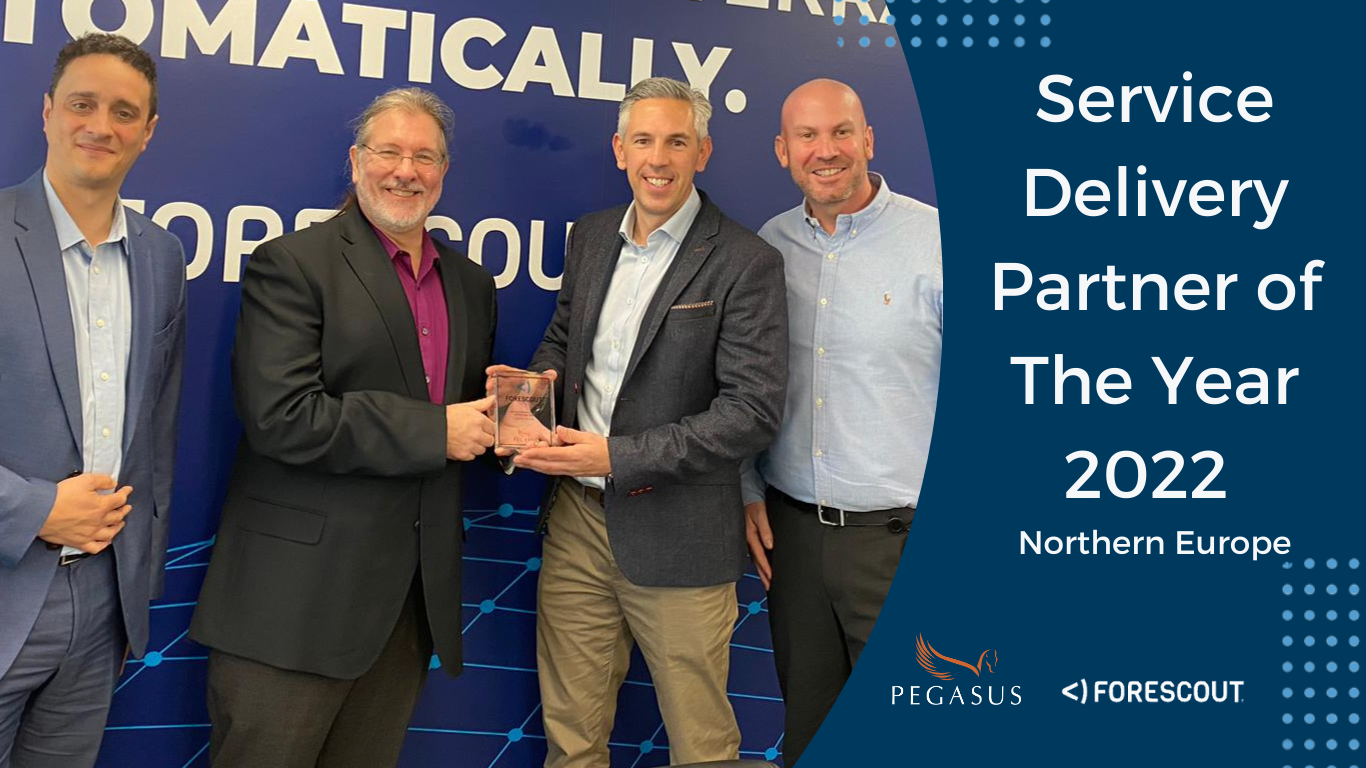
Cybersecurity firm Forescout recognises Pegasus for investment, commitment and technical excellence. Earlier this April, Pegasus Consultancy was awarded the Service Delivery Partner of the Year 2022: Northern Europe award from Forescout. Pegasus Co-Founder Chris Caruk and Director Will Cass were delighted to accept the award from Forescout VP Europe Matt Poulton. Chris and Will accepted the award while attending the Forescout Partner Tech Day on 4 April 2023 at Forescout’s London headquarters. This event was a conference where delivery partners could learn more about Forescout’s role in client security and how to approach challenges. A sunny lunch on board a narrowboat rounded out the day. Chris said, “I was extremely proud to accept the Service Partner of the Year award on behalf of Pegasus. Our relationship with Forescout reflects our ethics and values, and we are thrilled to continue developing our partnership in the coming years.” Pegasus has partnered with Forescout since 2021 to deliver digital security services for the European, Asian and Middle East markets. Pegasus brings its network security expertise to the syndicate while Forescout’s automation aligns security frameworks across all digital assets. Forescout has focused on visibility and continuous compliance to build strong and vigilant systems for Fortune 100 companies. Together we are able to meet and exceed client expectations for risk detection and mitigation, as well as top-tier security scalability. Pegasus’s commitment to distinction in professional services (PS) and residencies has been part of our story since we started. Our worldwide bank of engineers is drawn only from the best in each field and subject. Our global reach allows us to deploy anywhere, anytime. Speed is a necessity in digital services, especially security. Our fast responsiveness plus skillful handling and subject expertise is what makes Pegasus stand out as a Forescout partner. This award validates our pledge to prioritize people, and we will continue to invest in our teams. Looking ahead through 2023 and into 2024, Pegasus will continue to invest in its Forescout capabilities across the Western Europe market. Already we have established Forescout PS residencies in Germany, Saudi Arabia and UK. We are proud to be part of the Forescout success story!
How partnering can enrich your end service results

Partnering certain skills through strategic partnership can prevent diversion of resources—time, money and people—toward building a skillset that has a limited return, especially in software development. Knowledge sharing within a company is a communication and training matter. Not all knowledge and skills are permanently required. Partnering with a company to deliver subject matter specialisms and technical skills means you can still give your clients a high level of expertise, and you can do so rapidly, even instantly. Anteing Up At Pegasus, we live by our company values. Our focus is and always has been on: – Integrity– Innovation– People– Dependability, and– Partnership That means that we strive to support our most important resource—our people—by creating an environment that is creative, open, collaborative, and trusting. And that includes how we work with our external partners and clients. What’s at stake? Although we directly consult on a wide range of tech solutions, Pegasus has a particular partnership specialism with software vendors to extend their delivery of client services. This is how it works. You have a crack team of developers, some fantastic applications, and customers who are interested or ready to implement them. Perhaps, however, you don’t have some or all of the following: – A big enough team to deploy to many clients at once– The ability to travel on-site to distant clients– Client support in local customer languages– Knowledge of regional business customs for global clients– Training capabilities We tap our teams to deliver these types of services—and many more—on your behalf, no matter where we’re needed. We have hubs around the world staffed by multi-lingual tech experts, highly-skilled developers, software trainers, and field engineers who know how things work in every area. It’s even possible that your team requires a subject matter expert on-site to assist with a particular project. If your client is in a niche industry, then ensuring that your application is going to integrate with their systems and meet their needs will require someone on your side who gets it. Pegasus can provide that, too. We have first-hand experience in many high-growth industries, as well as several smaller ones. So by partnering these services with a company like Pegasus, you are gaining that experience onto your team for the duration of your project. The house wins But it’s not just about Pegasus. Partnering with a trusted partner, and trusted partner to take care of boots-on-the-ground services is proven to free up in-house resources. That means you can focus on strategic moves like product development, long-term business planning, market moves, and even capital investment. When we say “resources”, we are talking about all resources. Your people will be free to focus on what they do best, whether that’s actual coding or marketing, or closing the deal. But it also means money. You won’t be sinking funds into overheads for staff you don’t need or skills that get used once or twice, never to be needed again. Instead that savings can be allocated towards training that matters to all of your clients—certifying your developers, for instance—or hiring staff with skills you do need—a specialist project manager, perhaps. All in Part of how the savings work is that partnering is scalable. Project A needs 10 people, but Project B needs 18 people. Project C, which overlaps B, is going to need 12. Next year, Project D only needs 3. If you were having to work with your own staff, this would be a nightmare. By the time you’d finished recruiting for A, B, and C, you’d have to start laying people off before D. Your HR department would have to be big, which would itself be an overhead drain. By partnering, you get as many people as you need on the job when you need them, where you need them. A good partner will be an extension of your brand. Therefore they have to ensure that they have not only their own clear standards but will also uphold all your values. What the partnership brings to the table varies from one company to another. What Pegasus brings is: – Range of industry experience– Global connections and regional knowledge– Technical expertise– Scalability of services Your ace in the hole The services we provide on your behalf let you focus on software development and deployment for your clients. And it also allows you the chance to take strategic stock of your own company’s direction. Leave the practical to Pegasus – Subject expert residencies– Software development and integration– Local language field engineering– Team training We’d love to talk with you more about how partnering up could work. Contact us for a chat.
How to speak the same language with your clients?

Forging a strong human connection is key to good customer support and long-term client retention. Partnering with Pegasus can help. Partnering up for real connection Forging a strong human connection is key to good customer support and long-term client retention. Partnering with Pegasus can help. If the covid pandemic has taught us anything, it’s that humans really value face-to-face communication. When it’s taken away, we find ourselves struggling a bit to make sense of just about everything. For businesses that have pivoted to remote delivery and support, such as software vendors, this causes something of a conundrum. On the one hand, now more than ever, people are craving connection. On the other, there are a lot of very good reasons to limit travel to client sites now and in the future. In fact, even before covid, decreasing business travel for environmental concerns was already factoring into many companies’ social responsibilities. Mass uptake of remote working during the pandemic made it clear just how much of an impact work travel has on the environment. But when it comes to technical deployments, there are some aspects that are just done best in person. Client training, field engineering, and even the research and discovery phase are all usually best performed on-site. Even when those clients are in different regions of the world. There’s a way to do that without ● Travelling unnecessarily● Adding more people to your payroll, or● Upskilling staff with one-time-use, regional knowledge. Share the work Partnering with technical services centers of excellence (CoE), like Pegasus allows vendors to provide a personal, up-close service to distant clients. Pegasus is already there. We have regional hubs across the world, strategically situated to deliver partner services into emerging and other fast-growing digital markets. Our physical presence in these areas means we can be there on your behalf. A CoE allows you to trust that your own post-sales services can be delivered to a top standard while leveraging proximity to clients as well as local knowledge. We can provide you with premium expertise in direct customer support, from project consulting to development to troubleshooting: ● Field engineering● Development & integration● System and technical training● Residency programs● And more… Add skills without overheads But Pegasus is more than just boots on the ground. Yes, we are present in places you may not be able to go right now, which is handy given the state of world travel. But when the world opens back up, will you be ready to conduct business in other global regions? Do you have regional knowledge, and an understanding of business customs? Do you have staff who speak the local language? If not, you may be missing out on more than you realize. We all know that poor customer service loses us, clients. But even good customer service that the client can’t understand is going to be a problem. Speaking the client’s native language makes a substantial difference in customer retention. And that’s for both in-person and remote customer support. Fully 29% of software vendors have lost customers just because of language barriers. On the flip side, 70% of clients report feeling loyalty to technology brands that do provide multilingual support in their language. So there’s a big incentive to figure out how to talk to your clients in their own language. Get everyone to speak the same language When you’ve got a product-like software that is deployed truly globally, attempting to hire staff who can keep pace with every market is going to be tricky. One week you may have a product deployment in Turkey, the next week, Nigeria, and a month later, Argentina. Instead of expecting your clients to deal with the language your staff work in, you can partner with a technical CoE that speaks the language. Pegasus’s team members are multilingual and multi-talented. We pool expertise in software development and integration, tech strategy, corporate training, and field engineering to deliver top-quality vendor services for our partners on-site and remotely, white-labeled or branded, speaking both the client’s literal language and their business language. You can create those personal connections everywhere your technology is used. At a time when “remote” is the big buzzword, you can get close without compromising social responsibility. And through partnerships with Pegasus CoE you can do it without adding operational complexity, headcount, or other overheads to your balance sheet. Want to talk more about how to partner with Pegasus? Get in touch here: Contact Pegasus!